what is the process that plants use to make food
Abstract
The food we swallow ultimately comes from plants, either straight or indirectly. The importance of plants equally the global kitchen can never be underestimated. Plants "swallow" sunlight and carbon dioxide to produce their own food and food for the millions of other organisms dependent on them. A molecule, chlorophyll (Chl), is crucial for this process, since information technology absorbs sunlight. Notwithstanding, the way land plants produce their food is very different from the way plants in the oceans produce their food. Since it is difficult for light to reach underneath the water in the oceans, nutrient production, scientifically called photosynthesis, becomes very slow. Phycobiliproteins are proteins that make this chore easier, by absorbing the available light and passing information technology on to Chl. These phycobiliproteins are found in tiny, invisible organisms called cyanobacteria. Their "food-producing" reactions are disquisitional for the survival of many living organisms like fish, birds, and other sea life. It is, therefore, very important for anybody to understand how cyanobacteria make their nutrient, and what important roles the phycobiliproteins play in the process.
How Practise Living Things Obtain Their Food?
When y'all retrieve of food, do you usually come upward with images of your favorite nutrient? This is a natural process, since food is important for every living thing. To fulfill this bones need, all living things either make their own food or get it from some other source. Humans tin can swallow both plants and animals. Some animals consume other animals, while some animals consume plants as their food. Ultimately, nosotros meet that everybody on this planet is dependent on plants for their food. But then, what do plants swallow? Actually, plants "consume" sunlight and a gas called carbon dioxide, both of which are easily available right here on earth. The procedure by which country plants produce their own nutrient using sunlight and carbon dioxide is known equally photosynthesis (Figure 1). While carbon dioxide is absorbed by the leaves, the sunlight is captured past a chemical molecule in the institute, called chlorophyll (Chl). All photosynthetic organisms contain Chl.
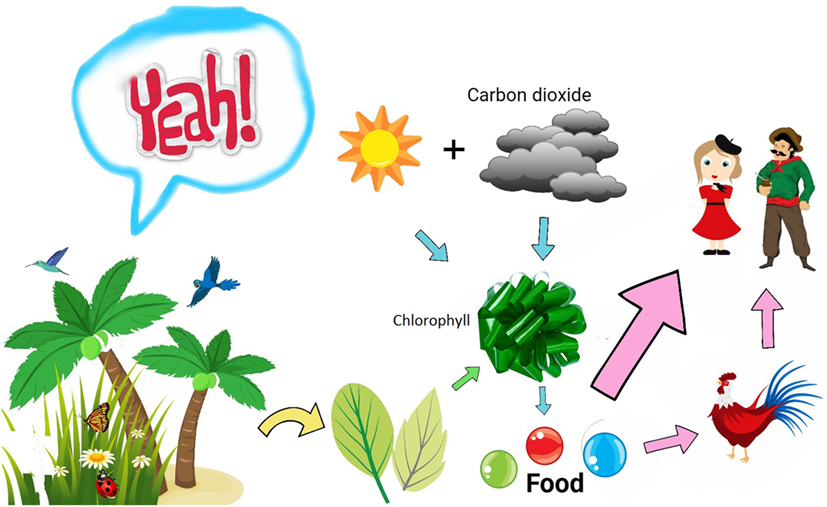
- Effigy 1 - A simplified view of how plants produce food for us.
- The leaves of dark-green plants contain chlorophyll, which absorbs sunlight for producing food. This food is then used by the establish itself as well as other animals, including humans.
However, the way land plants perform photosynthesis does non assist the organisms living in the oceans, which embrace virtually 70% of our earth. Plants in the oceans face bug with light availability. The blue and green portions of light penetrate into the h2o more than the yellowish and red portions of lite do (Figure 2). Luckily, ocean plants become help in producing food from such limited light and carbon dioxide, from tiny microscopic microbes called blue-green alga (as well known as blue-green algae). These microbes have adapted to dim light weather, and they carry out photosynthesis both for themselves and for the benefit of other living things. Cyanobacteria are aboriginal microbes that have been living on our world for billions of years. Cyanobacteria are said to be responsible for creating the oxygen-filled atmosphere we live in [i]. For carrying out photosynthesis in low light conditions, cyanobacteria have the help of proteins called phycobiliproteins , which are plant cached in the cell membranes (the outer covering) of the cyanobacteria.
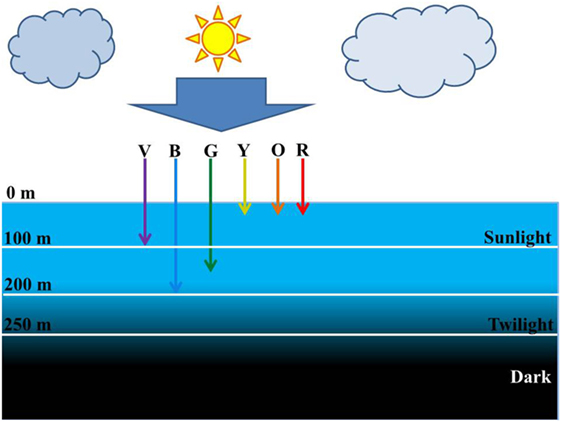
- Figure ii - Penetration of sunlight in oceans.
- Sunlight is equanimous of different colors: V, violet; B, blueish; 1000, green; Y, yellow; O, orange; and R, red. The blue and green colors attain up to 200 1000 inside water, while all the other colors including violet tin attain only up to the first 100 thou inside the oceans. The arrows represent the depth to which different colors of calorie-free attain the oceans.
What are Phycobiliproteins?
Phycobiliproteins play the part of administration to Chl in aquatic (water) environments. Since light has a difficult fourth dimension penetrating into the oceans, phycobiliproteins make this task easier by absorbing whatever light is available; they absorb the green portion of the light and turn information technology to ruby calorie-free, which is the color of lite required past Chl [2]. However, changing the color of light is not as easy as information technology seems. The green light has to pass through unlike phycobiliprotein molecules, which absorb light of 1 color and give out light of another color. The color that is given out is then taken up past a second phycobiliprotein, which turns it into a third color. This process continues until the emitted low-cal is ruby, which tin can finally be taken upward by Chl. For this whole process to take place, we have iii unlike kinds of phycobiliprotein molecules bundled as a sort of a hat over the Chl molecule, every bit you can see in Figure 3. These 3 kinds of phycobiliproteins are:
-
(a) C-phycoerythrin (CPE), pinkish-red in color and responsible for absorbing the green portion of sunlight.
-
(b) C-phycocyanin (CPC), deep blue in colour and responsible for absorbing the orangish-crimson portion of sunlight.
-
(c) Allophycocyanin (APC), calorie-free blue in colour and responsible for absorbing the cerise portion of sunlight.
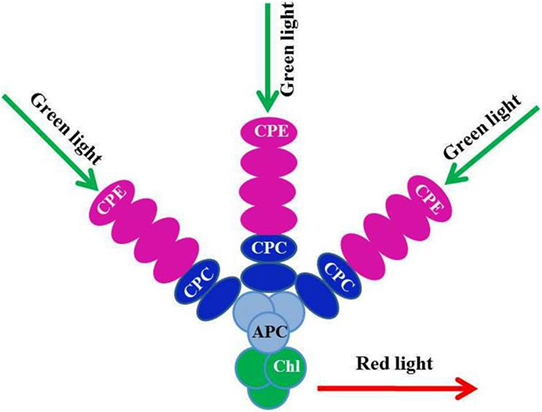
- Figure three - Chapeau-like organisation of phycobiliproteins and chlorophyll (Chl) in cyanobacteria.
- The dark-green low-cal is first absorbed by C-phycoerythrin which passes it on to C-phycocyanin (CPC). CPC further passes the light energy to allophycocyanin (APC) which transfers it to Chl for photosynthesis, using the ruby-red light.
The reason phycobiliproteins absorb low-cal of unlike colors is that they contain chemical molecules called bilins inside them, which give them their vivid colors. These bilins are responsible for absorbing light of i color and emitting low-cal of another colour, thus causing a change in the colour of light. Advanced instruments have allow the states analyze the organization of these molecules and proteins in the blue-green alga. We know that phycobiliproteins are shaped like disks [iii], and the disks are stacked on top of each other to form the hat-like structure. Ane finish of the stack is fabricated of CPE, whereas the other cease is made of CPC. This assembly joins to the core, made of APC. This unabridged construction is linked to Chl, which accepts the red light emitted past APC. The arrangement of the lid-like structure has been shown in Figure 3.
How Does the Light Free energy Transfer Take Identify in Phycobiliproteins?
The change in light color from light-green to red takes place through a procedure known equally fluorescence . Let us see what fluorescence is. Imagine a transparent container filled with a pink-colored liquid that, when illuminated with a flashlight, shines a brilliant orange! That is exactly what CPE does (Figure four). All phycobiliproteins possess this heady belongings of giving off visible lite of a color different from the color of light that is shone on them. After CPE changes green light to yellow-orange, CPC takes up the yellow-orangish calorie-free and changes information technology to lite red. APC takes upwardly this light-cerise light and changes information technology to a deep red light for Chl. Then, at present nosotros have the green light changed to blood-red, which is the color of light that nature intended Chl to absorb. The entire process is a sort of a relay race, where each participant picks upward where the previous one left off (Figure 5). These phycobiliproteins are an important part of the tiny microscopic organisms called cyanobacteria, which conduct out photosynthesis in much the same way equally land plants practice. The but difference is that they use a different set of chemic molecules—cyanobacteria utilize phycobiliproteins while land plants use Chl.
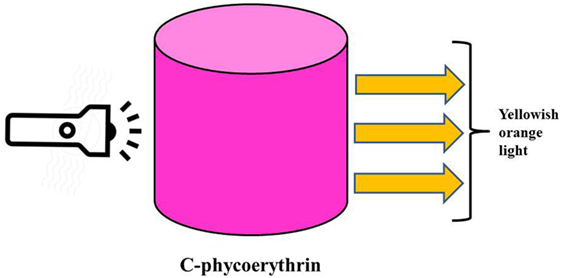
- Figure 4 - Fluorescence belongings of C-phycoerythrin (CPE).
- The white color of the light produced past the flashlight is inverse to yellowish-orange light by CPE, to exist taken up by C-phycocyanin.
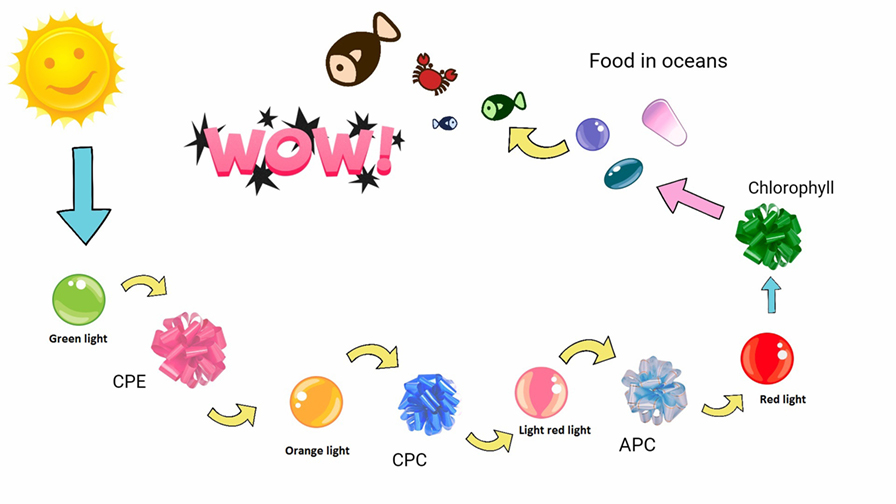
- Figure five - Phycobiliproteins change the color of light from dark-green to red, so that it can be used for photosynthesis.
- The greenish-colored light is taken upward past C-phycoerythrin (CPE), which changes the color of the light to yellowish orangish. The orange calorie-free is taken up by C-phycocyanin (CPC), which further changes information technology to light carmine. The light carmine color is absorbed by allophycocyanin (APC), which changes it to blood-red colour. The cherry-red color is finally absorbed past chlorophyll, for producing nutrient through photosynthesis.
What Did We Learn?
So, we now know that photosynthesis is the process past which plants produce their food, using Chl. Nosotros also know that the reduced corporeality of light available in the oceans decreases this photosynthetic process. Nature has evolved some helper chemical molecules known as phycobiliproteins, which are able to absorb the colors of low-cal available in the oceans and turn this light into a color that Chl molecules can use. These phycobiliproteins are establish in tiny, invisible-to-the-naked-heart blue-green alga, whose photosynthesis is responsible for providing food for the living organisms in the oceans and too for making the oxygen in our atmosphere that nosotros breathe every second. Isn't it exciting that these tiny organisms can make such a divergence to marine life? In the future, nosotros hope to gain more understanding of the functions of phycobiliproteins and the roles that they may play for the benefit of mankind.
Glossary
Photosynthesis: ↑ A process by which plants produce food for themselves and other organisms using sunlight and carbon dioxide gas.
Chlorophyll: ↑ A chemical molecule present in plants that absorbs the sunlight for photosynthesis.
Phycobiliproteins: ↑ Colored pigments found in cyanobacteria and certain other organisms, which help in photosynthesis by arresting certain colors of light which chlorophyll cannot absorb.
Fluorescence: ↑ The property of certain compounds to absorb ane colour of light and to requite off some other colour. Phycobiliproteins use this property to change the color of calorie-free they absorb then that the lite can be used for photosynthesis.
Disharmonize of Interest Statement
The authors declare that the research was conducted in the absence of whatsoever commercial or financial relationships that could exist construed as a potential disharmonize of interest.
Acknowledgements
This manuscript has been assigned registration number CSIR-CSMCRI – 114/2016. TG gratefully acknowledges AcSIR for Ph.D. enrollment and CSIR (CSC 0105) for financial support.
References
[1] ↑ Sidler, W. A. 1994. Phycobilisome and phycobiliprotein structure. In: Bryant, D. A., editor. The Molecular Biology of Blue-green alga. Dordrecht: Springer. p. 139–216.
[ii] ↑ Ghosh, T., Paliwal, C., Maurya, R., and Mishra, South. 2015. Microalgal rainbow colours for nutraceutical and pharmaceutical applications. In: Bahadur, B., Venkat Rajam, Yard., Sahijram, 50., and Krishnamurthy, K. V., editors. Constitute Biology and Biotechnology: Volume I: Found Diverseness, Organization, Role and Comeback. New Delhi: Springer. p. 777–91.
[3] ↑ Satyanarayana, L., Suresh, C. Thousand., Patel, A., Mishra, S., and Ghosh, P. K. 2005. X ray crystallographic studies on C-phycocyanins from blue-green alga from unlike habitats: marine and freshwater. Acta Crystallogr. Sect. F 61(nine):844–seven. doi:10.1107/S1744309105025649
Source: https://www.frontiersin.org/articles/223603#:~:text=Photosynthesis%3A%20%E2%86%91%20A%20process%20by,sunlight%20and%20carbon%20dioxide%20gas.
0 Response to "what is the process that plants use to make food"
Post a Comment